CLIENT UPDATE
New regulation for handling business partnership cases by the competition regulator: improvement for large businesses… or setback?
PUBLISHED DATE
JUL 02, 2024
-7.webp&w=3840&q=75)
CONTENT
- No sections yet
Approximately 66 million businesses in Indonesia are categorised as micro, small and medium enterprises (MSMEs). Such enterprises play a significant role in Indonesia’s economic growth, contributing some 61% of Indonesia’s Gross Domestic Income and employing around 97% of the total labor force. 1 Many MSMEs enter into partnership agreements with larger businesses to
expand, but in some cases find themselves vulnerable targets prone to exploitation, mainly due to their unequal bargaining power. This situation has led to disputes over violations of Law 20 of 2008 regarding MSMEs (as amended) (the MSME Law), particularly in relation to disputes between partnerships between MSMEs and large businesses. 2
The Indonesia Competition Commission (locally known as KPPU) is responsible for supervising partnerships, including the handling of partnership cases. To implement the MSME Law, the KPPU recently enacted KPPU Regulation 2 of 2024 on Partnership Case Handling and Supervision (the New KPPU Regulation) which revoked KPPU Regulation 4 of 2019 (the Old KPPU Regulation).
Overview of the changes
Under the New KPPU Regulation, the partnership supervision framework continues to target MSMEs engaged in business partnerships with large businesses. Various provisions regulating how the KPPU manages partnership cases changed significantly under the New KPPU Regulation.
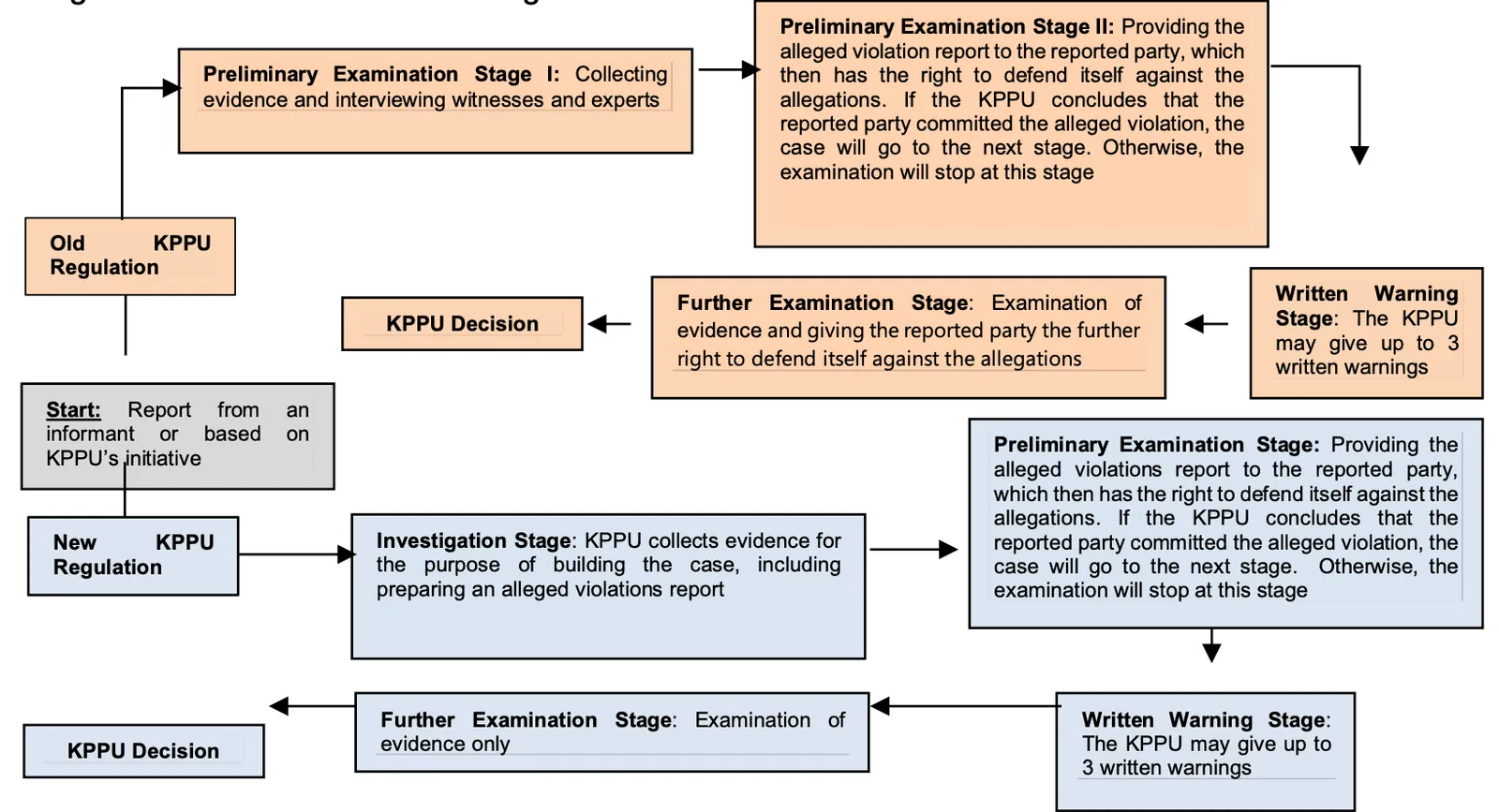
We set out below a table highlighting the main differences between the Old KPPU Regulation and the New KPPU Regulation as they relate to KPPU partnership case supervision.
Aspects | Old KPPU Regulation | New KPPU Regulation | Comments |
|---|---|---|---|
New “investigation” stage | There are no specific provisions regarding the investigation stage for partnership cases. | Investigations into alleged partnership violations are conducted over a period of 60 working days, with the possibility of extension by up to 30 working days. | KPPU is now able to gather sufficient evidence to indicate that a business actor may have violated the MSME Law during this new investigation stage. |
Preliminary examination stage | Two stages of examination:
| Simplification of stages, where the preliminary examination stage includes presenting an “alleged violations report" to the reported party and giving the reported party to the right to defend itself against the allegations. 5 | The collection of evidence and interviewing of factual witnesses/ experts now take place during the investigation stage. |
Defence to allegations | The reported party has the right to defend itself against the allegations during Stage II of the preliminary examination stage and to also defend itself at the “Further Examination Stage” (referred to in the flowchart below) by providing evidence. 6 | The reported party only has the right to defend itself during the preliminary examination stage 7 not at the “Further Examination Stage” (referred to in the flowchart below). | The New KPPU Regulation represents a significant setback for reported parties. They are now only allowed to defend themselves against accusations of violating the MSME Law during the preliminary examination stage. |
Written warning stage Note: Under both the Old KPPU Regulation and the New KPPU Regulation, if KPPU accepts the alleged violations report and determines that there has been a MSME Law violation, KPPU can give a maximum of three written warnings to the reported party, including the possibility of an extension, together with recommendations as to what the reported party must do to stop the violations. |
| • The KPPU can also give up to three written warnings, each for a specific duration 10 • The reported party can only apply for an extension of the first written warning.11 | The New KPPU Regulation allows reported parties more time (compared to the Old KPPU Regulation) to implement the KPPU’s recommendations and cease to violate the MSME Law. The additional time gives the reported party a chance to comply with the KPPU’s recommendations, providing an opportunity for the investigation to be dropped if the reported party complies with KPPU’s recommendations for the period determined by KPPU. |
Procedures for handling partnership cases under the New KPPU Regulation
The changes in procedures for handling cases under the New KPPU Regulation (see the above table) have resulted in significant alterations in the examination of partnership cases. Please see below a comparison chart regarding the handling of cases by KPPU based on the Old KPPU Regulation and the New KPPU Regulation.
Appeal status of the KPPU’s decision
One matter that remains unclear in the New KPPU Regulation is the appeal status of the KPPU’s decision on partnership cases. Both the New KPPU Regulation and the Old KPPU Regulation state that the KPPU’s decision on partnership cases is final.12 However, this provision conflicts with a Supreme Court Regulation that provides a mechanism for businesses to appeal KPPU decisions to the Commercial Court (SC Regulation). 13 We are already aware of a 2022 KPPU precedent concerning a farming partnership that was successfully appealed by the reported party to the Commercial Court, but was ultimately overturned by the Supreme Court.14
Key takeaways
The New KPPU Regulation may potentially benefit as well as burden large companies that have partnerships with MSMEs. In the early stages, large companies are given more time to remedy their mistakes, thereby mitigating the risk of an investigation going further. The additional opportunity to remedy mistakes reduces the likelihood of a large company being found guilty of violating the MSME Law and being penalised. However, if the investigation does proceed, the reported party will have less opportunity to provide a defence, since the New KPPU Regulation does not allow a reported party to present a defence against the allegations at the “Further Examination Stage” (see above flowchart). Such an additional defence opportunity was permitted at the Further Examination Stage under the Old KPPU Regulation). 15
Although it remains unclear whether a KPPU partnership case decision can be appealed to the Commercial Court, a recent “focus group discussion” held by the Supreme Court, which included KPPU and all the relevant stakeholders, the Supreme Court indicated its tendency to allow such appeals.16 If the Supreme Court wishes to take concrete action on the ability of losing parties to appeal KPPU partnership case decisions, it is likely that the Supreme Court will revise the SC Regulation to include a provision allowing businesses to appeal KPPU decisions in partnership cases
References
01
https://kadin.id/data-dan-statistik/umkm indonesia/#:~:text=Pada%20tahun%202023%20pelaku%20usaha%20UMKM%20mencapai%20sekitar%2066%20juta
02
Large businesses are generally considered to be businesses with capital of more than 10 billion Rupiah and annual sales of more than 50 billion Rupiah
03
Articles 22 to 24 of the Old KPPU Regulation
04
Article 28(3) of the Old KPPU Regulation
05
Article 42(2) (a) and (b) of the New KPPU Regulation
06
Article 28(4) and 48(3) of the Old KPPU Regulation
07
Article 42(2)(b) of the New KPPU Regulation
08
Articles 34(2) of the Old KPPU Regulation
09
Article 34(5) of the Old KPPU Regulation
10
Article 47(1) of the New KPPU Regulation
11
Article 48(1) of the New KPPU Regulation
12
Article 66(4) of KPPU Reg 4/2019 and Article 62(4) of the New KPPU Regulation
13
Supreme Court Regulation No.3 of 2021 regarding Procedures for Filing and Examination of Objections of the KPPU in the Commercial Court
14
Please see KPPU Decision Number 09/KPPU-K/2020 and https://kppu.go.id/blog/2022/12/mahkamah-agung-menangkan-kppu-dalam-kasasi-putusan-kemitraan-atas-pt-sinar-ternak-sejahter/
15
Article 48(3) of the Old KPPU Regulation
16
Please see article entitled “FGD Penelitian “Kewenangan Pengadilan Niaga Dalam Mengadili Keberatan Atas Putusan KPPU” (in Indonesian only) at the following link: https://ebook.bldk.mahkamahagung.go.id/index.php/2021/09/24/fgd-penelitian-kewenangan-pengadilan-niaga-dalam-mengadili-keberatan-atas-putusan-kppu/
AUTHORED BY