CLIENT UPDATE
Looking back at 2025, and the 2026 outlook: Indonesian competition & antitrust
PUBLISHED DATE
APR 20, 2026

CONTENT
- No sections yet
Overview
Our antitrust law practice looks back at the major developments in Indonesia’s competition and antitrust landscape in 2025 and explores what we may expect in 2026.
In this client update, we briefly review the following key matters:
- Competition & antitrust in 2025: by the numbers
- Merger filings
- Competition compliance programs
- Competition & antitrust legislation
- A new development for KPPU: transition to civil servant status
- Breakthrough in 2025: the first antitrust immunity precedent
- Outlook for 2026: KPPU’s main concerns and agenda
Competition & antitrust in 2025: by the numbers
We set out below several key statistics regarding Indonesia’s competition landscape in 2025:
13 competition law cases rendered, consisting of seven unfair competition cases, five late merger notification cases and one partnership case, with total administrative penalties of IDR698.5 billion (approx. USD41.7 million).1 | 4 companies have obtained Indonesia Competition Commission (locally known as KPPU) approval for implementing a compliance program.2 |
122 merger & acquisition filings with a total collective transaction value of IDR1.09 quadrillion (approx. USD65.07 billion) primarily in the real estate, mining and logistics sectors.3 | 12 policy advocacy recommendations issued to the Government.4 |
1 matter involving antitrust and competition immunity.5 | 4 registered cases concerning the protection of micro, small and medium enterprises (MSMEs), consisting of two cases in the retail sector, one in the poultry farming sector, and one in the healthcare service sector.6 |
In 2025, KPPU handled cases involving 24 businesses, eight of which were foreign (non-Indonesian) entities.7 Among those cases, KPPU rendered a decision in a case involving various Sany group companies concerning allegations of vertical integration and market control in early August 2025. The decision set a record for the largest administrative fine ever imposed by KPPU, amounting to IDR449 billion (approx. USD26.81 million).8
Other major cases decided by KPPU involved global technology companies, including Google LLC and TikTok Nusantara (SG) Pte. Ltd.9
We summarise below some of the more important competition cases that were heard before KPPU in 2025:
KPPU fined PT Arkindo IDR1 billion (approx. USD59,701), and three other companies were banned from regional government tenders for two years due to coordinated bidding practices (Sintong Bridge). |
KPPU fined TikTok Nusantara (SG) Pte. Ltd., IDR15 billion (approx. USD898,204) for the delayed notification of the share acquisition of Unlike a typical late notification case, the delay arose from an administrative error, rather than failure to meet the filing deadline. |
KPPU fined Perusahaan Umum Daerah Air Minum Amerta Dayan Gunung (formerly PDAM North Lombok) and PT Tiara Cipta Nirwana a total of IDR12 billion (approx. USD716,417) for coordinating the winner of a 2017 clean water procurement project. |
KPPU fined Louis Dreyfus Company Melbourne Holdings Pty. Ltd., IDR5 billion (approx. USD298,507) for a 9-business-day delay in the share acquisition notification of Emerald Grain Pty. Ltd. |
KPPU fined PT Dieselindo Utama Nusa and PT Rolls Royce Solutions Indonesia a total amount of IDR2.5 billion (approx. USD149,253) for unlawful coordination in a customs maintenance tender. |
KPPU fined Google LLC IDR202.5 billion (approx. USD12.089 million) for requiring application developers to use the Google Play Billing System (GBP System) with service fees of 15-30%. Google was ordered to cease the mandatory use of the GBP System and offer the User Choice Billing program with a minimum 5% service fee reduction for one year. |
KPPU fined PT CRRC Sifang Indonesia and PT Anugerah Logistik Prestasindo a total amount of IDR4 billion (approx. USD238,805) for creating sham competition/collusive bidding in a railway procurement. |
KPPU fined PT Maruka Indonesia IDR3 billion (approx. USD179,104) for conspiring with a former employee of PT Chiyoda Kogyo Indonesia to obtain trade secrets and establish a competing company.10 |
KPPU fined Trusty Cars Pte. Ltd., IDR1.5 billion (approx. USD89,552) for a 12-business-day delay in the share acquisition notification of PT Mitra Pinasthika Mustika Rent. |
KPPU dismissed a partnership case in relation to the cooperation between PT Kimia Farma Diagnostika with general doctors and dental practitioners. KPPU argued that such a cooperation agreement did not fall within the meaning of a partnership under the MSME Law, as this was a standard commercial cooperation, rather than a partnership involving MSME development.11 |
KPPU fined Mitsui & Co., Ltd., and Mitsui & Co. (Australia) Ltd., IDR1 billion (approx. USD59,701) for a one-business-day delay in the share acquisition notification of Position Partner Pty. Ltd. |
KPPU fined four Sany group entities a total of IDR 449 billion (approx. USD26,81 million) for vertical integration and market control in the sale of SANY trucks and spare parts in Indonesia. |
KPPU fined Compagnie Financière Michelin Société par Actions Simplifiée à Associé Unique (CFM) IDR1 billion (approx. USD59,701) for a 3-business-day delay for the share acquisition notification of PT Royal Lestari Utama. |
In addition to the above cases, on 3 November 2025, the Supreme Court rendered its decision in a case involving PT Jakarta Propertindo (Perseroda), PT Pembangunan Perumahan (Persero) Tbk., and PT Jaya Konstruksi Manggala Pratama Tbk., concerning procurement for the revitalisation of Taman Ismail Marzuki Jakarta Arts Centre. The Panel of Supreme Court Judges dismissed the judicial review request submitted by KPPU and upheld the Supreme Court decision in favour of the reported parties.
This decision is noteworthy in light of Supreme Court Regulation No.3 of 2021 on the procedures for handling competition cases (SC Reg 3/2021), which provides that a cassation constitutes the final legal remedy in competition cases and does not contemplate the availability of judicial review.12 However, this regulatory limitation was not expressly addressed in the decision’s reasoning, which has created uncertainty and confusion regarding the circumstances in which judicial review will be available in competition cases.
Notification filings
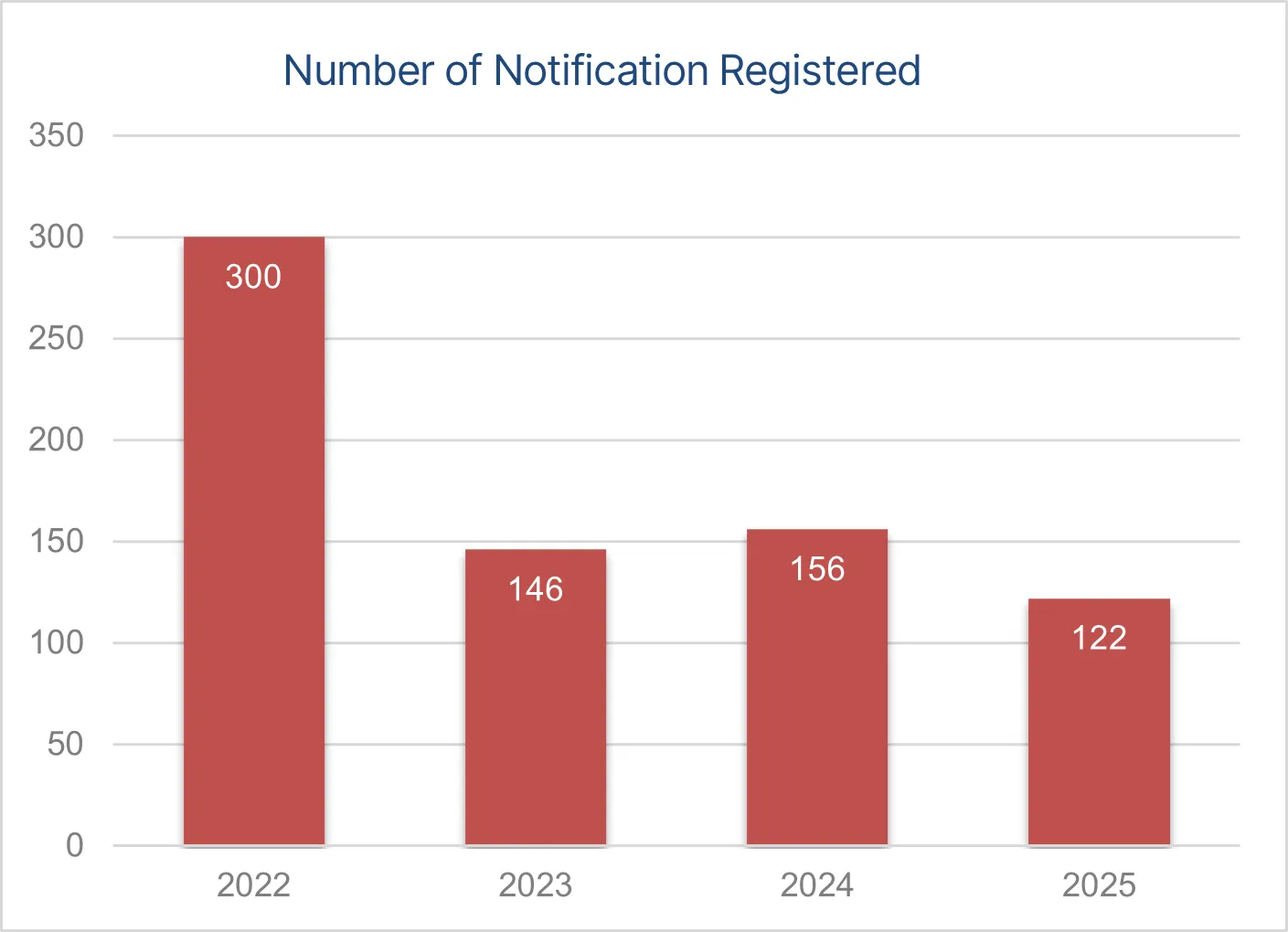
In 2025, KPPU registered a total of 122 notification filings, which is a 21.8% decrease from 2024, with a total of 156 notifications. The total value of transactions in 2025 reached more than IDR1 quadrillion (approx. USD60 billion), with the majority of industries concentrated in the real estate, mining and logistics sectors.13
Following the passage of KPPU Regulation No.3 of 2023, which introduced several changes to the mandatory notification requirements, the number of M&A matters submitted to KPPU has decreased by nearly 50% compared to 2023. For the last four years, the total number of notifications can be shown in the graphic below:
Competition compliance program
The KPPU’s formal competition compliance program is intended to increase awareness and encourage compliance with competition law. By applying for these programs, companies can receive leniency from KPPU if they were to violate a competition regulation in the future.
Throughout 2025, KPPU facilitated approximately 60 companies to apply for compliance programs, and by the end of 2025, four companies received formal compliance program registration.
We set out below the number of determinations issued by KPPU for the competition compliance program.14
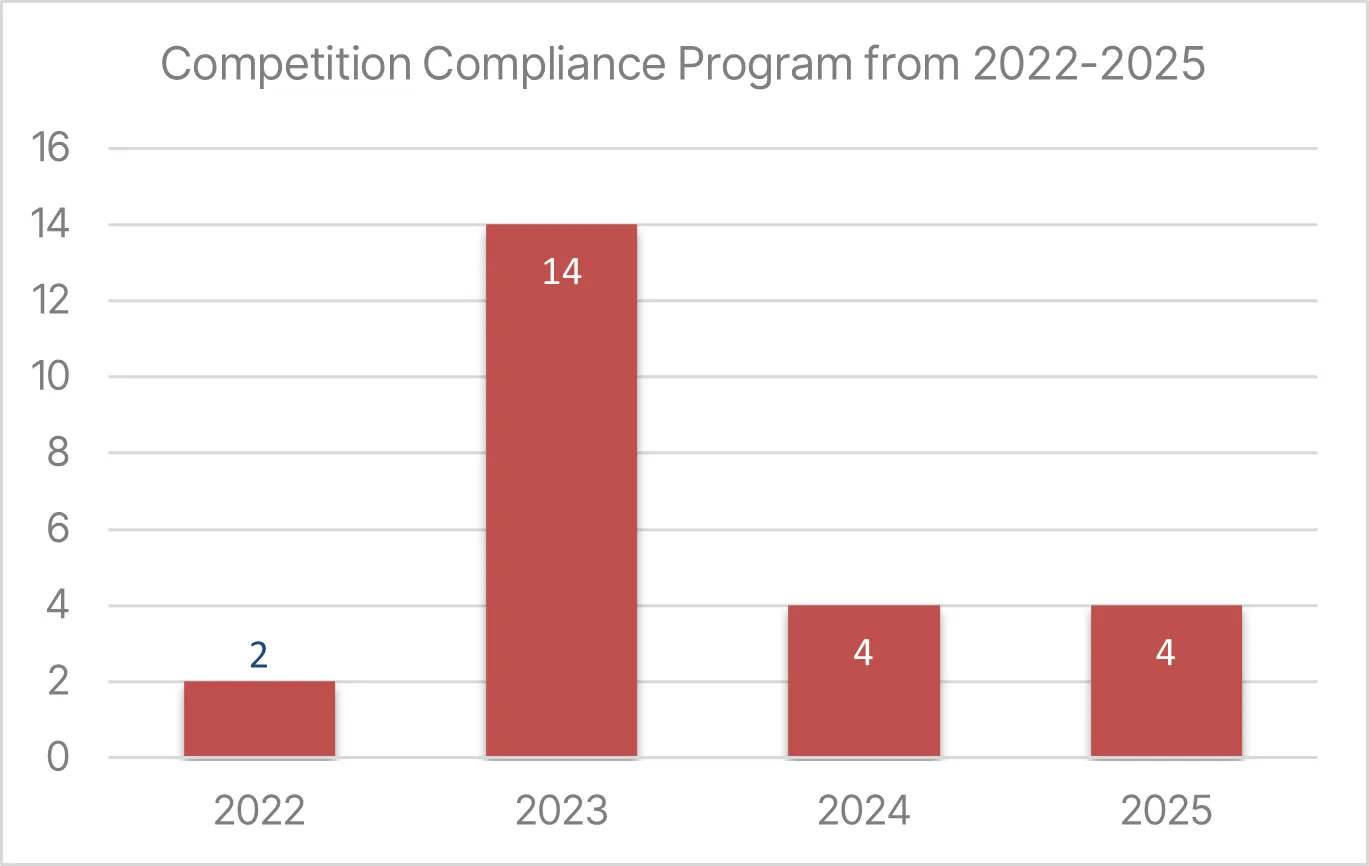
Since its launch in 2022, KPPU indicates that the competition compliance program has consistently shown a positive outcome for competition. Even though the program is still relatively new, KPPU is confident that its effectiveness can be evaluated based on the number of participating companies found to breach the competition law.15 KPPU further asserted that, as of the end of 2025, no participating companies had come to KPPU’s attention for breach of the Competition Law.16
Notwithstanding the above, the relatively low level of participation may suggest that the program is still perceived by many businesses as a voluntary or “nice-to-have” initiative, rather than as an integral component of their compliance obligations.
Competition & antitrust legislation
KPPU issued Regulation No.1 of 2025 on the KPPU Strategic Plan for 2025 to 2029, which came into force on 31 October 2025. The regulation discusses the KPPU’s role, functions, authority and organisational structure. Other than this regulation, no new regulations, amendments or guidelines were issued by KPPU in 2025.
A new development for KPPU: transition to civil servant status
KPPU reaffirmed its institutional transformation by appointing 394 employees as civil servants (locally known as ASN) in December 2025. KPPU’s chairperson emphasised that in addition to strengthening human capital, KPPU requires a robust legal framework that emphasises its nature as a government institution. The newly appointed ASN are expected to strengthen the KPPU’s capacity to enforce competition law and maintain an effective competition regime in Indonesia.
This transition will be an important milestone for KPPU, as it will likely have practical implications for KPPU’s internal governance by using the merit system of public sector governance standards. While the long-term impact remains to be seen, the transition to civil service status will influence how KPPU carries out its main functions in supervising competition law in Indonesia.
Breakthrough in 2025: First antitrust immunity precedent17
On 26 February 2025, KPPU issued its first conditional approval of a commercial cooperation agreement between PT Garuda Indonesia (Persero) Tbk., and Japan Airlines (Garuda-JAL case), subject to compliance with certain conditions imposed by KPPU.
In its decision in the Garuda-JAL case, KPPU concluded that the proposed cooperation was likely to generate greater benefits for consumers and the aviation industry, while noting that it would continue to monitor the implementation of such cooperation. KPPU also sought input from various stakeholders, including the Ministry of Transportation and relevant industry associations, and evaluated the Indonesia-Japan aviation market served by both airlines.
KPPU’s decision in the Garuda-JAL case represents a significant milestone and an important precedent, as it marks the first time KPPU has formally approved a commercial cooperation arrangement. While similar mechanisms are recognised in other jurisdictions, such as the concept of antitrust immunity in Japan, Indonesia currently lacks a specific regulatory framework that addresses the approval of such arrangements.
In this regard, we recommend that KPPU issue a formal guideline or a regulation governing the assessment and approval of strategic agreements. In the meantime, the above-mentioned case can be a reference point for companies that may wish to enter such agreements.
Outlook for 2026: KPPU’s main concerns and agenda
During the Competition Outlook 2026 event held on 26 January 2026, KPPU underlined that the digital sector would remain a priority for competition enforcement in 2026, considering the widespread use of technology and potential corporate actions among technology companies.
KPPU’s commitment to focus on the digital sector is also reflected in the commencement of another major case in the third quarter of 2025, such as a cartel arrangement relating to the setting of online lending interest rates, involving 97 financial technology platforms (Fintech Case). The case was recently decided by KPPU, which found all reported parties in the Fintech Case guilty of violating Article 5 of the Competition Law and imposed a total monetary penalty of IDR 755 billion (approx. USD442.1 million).
Following KPPU’s 2025 decisions involving major technology companies, including Google and TikTok, the Fintech Case may provide further insight into KPPU’s approach to competition issues involving digital markets, information exchange, and coordinated conduct of businesses in related markets facilitated through industry associations or digital ecosystems.
In addition to enforcement, we have also identified several key priorities for KPPU in 2026, as outlined below.
- Amending the Competition Law
As in earlier years, KPPU will continue to push for important amendments to be made to the Competition Law, which are expected to be finalised in 2026. The proposed amendments to the Competition Law made significant progress in 2025 by being listed in the priority legislation in the House of Representatives (Dewan Perwakilan Rakyat, DPR).19
The amendments are focused on strengthening KPPU through a number of fundamental aspects, such as the redefinition of legal subjects and relevant markets, a shift from post-notification to pre-notification on the merger control regime, and the enhancement of KPPU’s enforcement authority.20
The proposed amendments also seek to address concerns regarding a level playing field for MSMEs in the context of digital market expansion. KPPU’s goal of facilitating the Competition Law amendment process highlight KPPU’s central role as Indonesia’s competition regulator.
- Strengthening supervision on preferential treatment for state-owned enterprises (SOEs)
The proposed amendments to the Competition Law revisit the exemption granted to SOEs in respect of competition law provisions under Article 51 of the Competition Law.21 The DPR and academics have criticised Article 51 of the Competition Law for allowing SOEs to have exclusive rights (essentially permitting them to engage in monopolistic business activities) that may not be in the public interest. In practice, this exemption has raised questions about how competition rules should apply to SOEs, when they are granted exclusive rights by the government.
The SOE exclusive rights issue also gained attention after the third amendment of the SOE Law in 2025, which allowed the President to grant monopoly rights to SOEs. Further attention to the anti-competitive behaviour of SOEs has also arisen under “cooperation and consolidation programs” (commonly referred to as synergy programs) in respect of which certain SOEs are assigned to collaborate on particular projects. Synergy programs can raise competition law concerns, particularly when they involve exclusive arrangements.
Although there is a pending Government Regulation on the implementation of monopoly rights, it has not yet been finalised. In the meantime, KPPU will closely supervise the way SOE monopoly rights are managed in 2026, together with finalising amendments of the Competition Law.
- Sectors of concern
By applying its internal competition index to determine how competitive certain industrial sectors are, KPPU identified a number of sectors with low index scores. As a result of its findings, KPPU committed to intensifying its supervision of those sectors in 2026, including the energy, mining, water and waste management and construction sectors (together Targeted Sectors).
KPPU intends to enhance its monitoring program for the Targeted Sectors through advocacy and, if necessary, by using enforcement tools to improve the Targeted Sectors’ competition indexes.22
However, the effectiveness of such monitoring programs remains to be seen, as the Targeted Sectors have continued to show a low competition index over many years!
- Monitoring and enforcement platform
Under the KPPU’s strategic plan for 2025 to 2029, KPPU outlined its digital transformation roadmap in 2026 by developing a big data-based market monitoring platform. This initiative will begin with the establishment of core digital infrastructure, which is expected to have the facility to receive electronic reports and an automated merger evaluation system.
This strategic plan is a welcome initiative, as digital transformation has the ability to enhance KPPU’s effectiveness in merger control and competition law enforcement.
We will continue to monitor competition regulations and practices in Indonesia and will publish further updates as soon as any new developments come to light. For further information on our competition and antitrust law practice, please access our website: www.soemadipradjataher.com.
References
01
KPPU Press Release No.081/KPPU-PR/XII/2025 dated 31 December 2025 - https://kppu.go.id/media-publikasi/siaran-pers?id=11&tahun=2025
02
KPPU Stipulations - https://kppu.go.id/penetapan/
03
KPPU, Competition Outlook 2026, YouTube, 26 January 2026 - https://www.youtube.com/watch?v=ENOzKHqlm-g
04
Please see footnote 1
05
KPPU Press Release No.012/KPPU/PR-II/2025 dated 27 February 2025. For more information, please see our client update on the Japan Airlines-Garuda antitrust and competition immunity. - https://kppu.go.id/media-publikasi/siaran-pers?id=80&tahun=2025
06
Please see footnote 1
07
Please see footnote 1
08
Please see our client update on the Sany Case - https://soemadipradjataher.com/news-insights/kppu-breaks-its-record-with-its-latest-fines-for-competition-law-violations
09
Please see our client updates on the Google Case and the TikTok-Tokopedia Case https://soemadipradjataher.com/news-insights/kppu-issues-landmark-idr2025-billion-penalty-against-google-for-anticompetitive-behaviour https://soemadipradjataher.com/news-insights/small-error-major-consequences-kppu-fines-tiktok-nusantara-sg-pte-ltd-idr-15-billion-for-late-and-improper-merger-notification
10
Please see our client update on the Maruka Indonesia Case - https://soemadipradjataher.com/news-insights/indonesias-competition-regulator-rules-on-company-secrets-conspiracy-case
11
The KPPU Declares PT Kimia Farma Diagnostika Not Guilty in Alleged Partnership Violation Case - https://telusur.co.id/detail/kppu-menyatakan-pt-kimia-farma-diagnostika-tidak-bersalah-dalam-kasus-dugaan-pelanggaran-kemitraan
12
Article 16 of SC Reg 3/2021
13
Please see reference no.3
14
Please see reference no.2
15
Firyalfatin, Competition Compliance Program Plays a Role in Preventing Violations, Hukum Online, 22 January 2026 (Indonesian article).
16
Please see the above reference
17
Please see reference no. 5
18
DPR RI Decision No.23/DPR RI/I/2025-2026 on the Amendment to the National Legislation Program for the 2025-2029 Draft Laws and the Second Amendment to the National Legislation Program for the 2025 Priority Draft Laws
19
Komisi VI DPR RI, Strengthening the Definition, Authority, and Impact of Business Competition is the Focus of the Antimonopoly Law Revision JDIH Sekjen DPR RI, 9 September 2025 (Indonesian article). - https://jdih.dpr.go.id/berita/detail/id/59111/t/javascript
20
Hanifah Dwi Jayanti, The Priority of State-Owned Enterprises in the Competition Bill is Deemed Unfair to the Private Sector, Hukum Online, 7 February 2026 (Indonesian article). - https://www.hukumonline.com/berita/a/prioritas-bumn-di-ruu-persaingan-usaha-dinilai-tak-adil-bagi-swasta-lt69861e80aa45a/?page=1&_gl=1*11wxkhu*_up*MQ..*_ga*MTE3Nzg5NDQ4Ni4xNzcwNTY5MDA2*_ga_XVDEV3KKL2*czE3NzA1NjkwMDYkbzEkZzEkdDE3NzA1NjkxOTkkajYwJGwwJGgw
21
Fitri Novia Heriani, Business Competition Index Rises, Mining and Construction Sectors Lead the Lowest, Hukum Online, 8 January 2025 (Indonesian article). - https://www.hukumonline.com/berita/a/indeks-persaingan-usaha-naik--sektor-pertambangan-dan-konstruksi-paling-rendah-lt677e0159c5537/
FILE DOWNLOADS

AUTHORED BY