CLIENT UPDATE
Halal certification for the F&B sector is now in effect! Have you complied?
PUBLISHED DATE
OCT 30, 2024
-9.webp&w=3840&q=75)
CONTENT
- No sections yet
Overview
Goods or services (Products) are considered halal if they are prepared, stored, packed, distributed, sold and presented in accordance with the principles of Islamic law. As a country with a Muslim majority, having a set of comprehensive, enforceable regulations and procedures to determine when Products are halal plays a significant role in satisfying consumer demand and influencing consumer preferences. To provide a clearer distinction between halal and non-halal Products, the Government recently issued Government Regulation 42 of 2024 on the Organisation of Halal Product Assurance (New Regulation), which revoked Government Regulation 39 of 2021 of the same title.
The New Regulation continues to categorise Products individually and sets out numerous specific requirements for companies that produce both halal and non-halal Products. Each category is assigned a separate compliance deadline, and one such deadline, for the domestic food, beverage and butchery industries, passed on 17 October 2024 – the date on which the New Regulation was issued. The question is, have you complied with the requirements?
Halal certification, labelling and other significant requirements
The New Regulation requires imported, circulated and traded Products to obtain a halal certificate and for a halal label to be affixed to such Products, which is issued by the Indonesian Halal Product Assurance Organising Agency (BPJPH) in coordination with various agencies. Please note that not all Products are required to be certified, particularly certain natural raw and fresh ingredients, as well as non-hazardous chemicals. 1 On the other hand, Products that are considered non-halal must include a description indicating that the Product is non-halal.2
For imported Products, if a halal certificate has already been obtained from the country of origin, Indonesia will recognise the halal certification and labelling from that country. However, the issuing institution in the country of origin must have a reciprocal agreement with the Halal Regulator on mutual recognition of halal certificates. If no such agreement exists, the imported Product will still be required to obtain a halal certificate and label, if it sold or marketed in Indonesia. If imported Products have not obtained halal certification, the importer or their official representative must apply for halal certification.
To obtain the halal certificate and label (referred to above), a producer of a Product must appoint a certified halal supervisor, who must be Muslim with a broad understanding of Islamic law regarding halal matters and have received the necessary training. Their role includes ensuring that the manufacturing methods for the Products comply with the halal regulations and liaising with a certified halal auditor to confirm that the entire production process complies with halal standards.
Upcoming halal certification deadlines by sector
In addition to the domestic food, beverage, and butchery sectors, the deadlines for halal certification in other sectors are also approaching. We set out below the compliance deadlines for each sector.
No. | Sector | Deadline |
|---|---|---|
Imported food, beverage and butchery products. | 17 October 2026 | |
Natural medicinal products, quasi-drugs, and health supplements. | 17 October 2026 | |
Over-the-counter drugs and limited over-the-counter drugs. | 17 October 2026 | |
Prescription drugs, except psychotropics. | 17 October 2026 | |
Cosmetics, chemical products, and genetically engineered | 17 October 2026 | |
Clothing, head coverings, and accessories. | 17 October 2026 | |
supplies, stationery and office supplies. | 17 October 2026 | |
Class A medical devices according to law. | 17 October 2026 | |
Class B medical devices according to law. | 17 October 2026 | |
Class C medical devices according to law. | 17 October 2026 | |
Drug products, biological products and medical devices, the raw materials for which are not sourced from halal ingredients and/or the manufacturing process for which is not halal. | 17 October 2026 |
Key changes in the New Regulation
The New Regulation introduces many key changes that companies producing or importing halal Products must follow. These changes include the following:
- The New Regulation now requires companies that have obtained a halal certificate to ensure that their Products continue to be consistently produced using halal methods. Compliance with this requirement must be verified by a written statement of consistency for the halal Products, which can only be obtained after an evaluation has been conducted by [the Halal Inspection Agency (LPH)] of the system implemented to guarantee halal standards. This evaluation must be conducted once every four years; and
- the slaughter of animals must be performed by a slaughterer who “understands” Islamic Law principles. However, this provision remains unclear, as the implementing regulation regarding the qualifications of a halal slaughterer have yet to be issued.
Institution of halal product certification
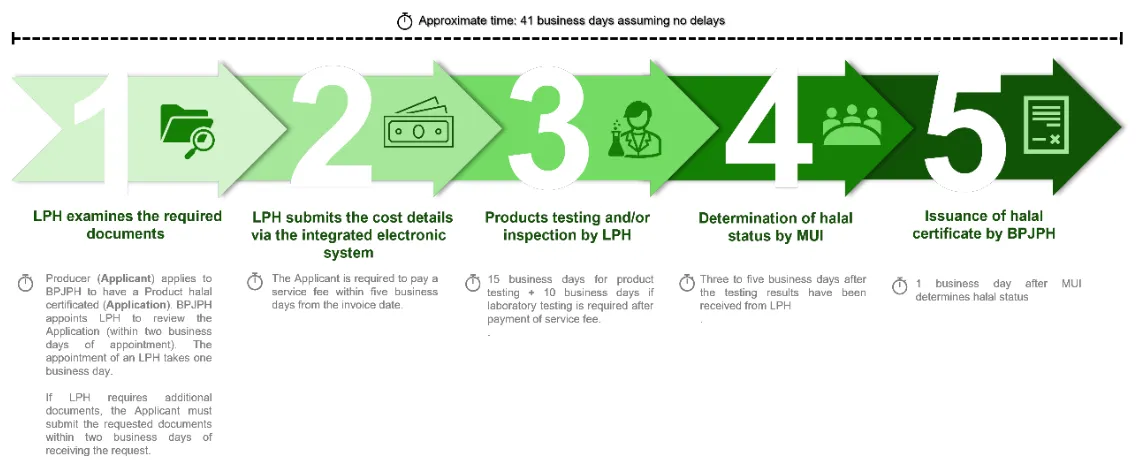
BPJPH was established in 2017 under Law 33 of 2014 on Halal Product Assurance (Law 33/2014). Since then, BPJPH has been issuing halal certificates, rather than the Indonesian Ulema Council (Majelis Ulama Indonesia, MUI). MUI is still responsible for holding halal fatwa hearings and determining Products’ halal status. However, halal certificates issued by MUI before Law 33/2014 will remain valid until their expiry. BPJPH is also authorised to establish norms, standards, procedures and criteria for Halal Product Assurance (Jaminan Produk Halal, JPH).
We set out below an indicative steps and timing chart for a producer obtaining a halal certificate for a Product.
What happens if you don’t comply?
With the deadline for the food and beverage sector having already passed, failure to affix a halal label on halal Products, or failure to describe a non-halal Product as such, may result in companies being penalised. Penalties range from a written warning and administrative fines, to the removal of the non-compliant Products from circulation.
The New Regulation also provides a mechanism for companies to appeal against a penalty, giving BPJPH authority to review and change or revoke the penalty.
Key takeaways
Domestic producers in the food, beverage and butchery sectors must now ensure that they comply with the halal requirements referred to above, as the government continues to strengthen the role of halal product assurance supervisors (JPH Supervisors) at all levels of government. JPH Supervisors, who provide the legal guarantee of Product “halalness”, are responsible for supervision of the halal regulations.
Considering the legislative intention to give Muslims comfort as to whether Products are halal or non-halal, as well as the potential penalties for non-compliance, it is in all Product producers’ interests to comply with the halal certification and labelling requirements. However, the severity of the penalties for breaching the halal Product requirements remains to be seen.
Although currently only halal requirements for the domestic food, beverage and butchery sectors are in effect, the halal compliance deadlines for many other business sectors will roll out over the next 10 years (as described in the table above).
Since the New Regulation was issued only recently, the success of its implementation remains to be seen. We will continue to monitor the regulations concerning halal certification and labelling and their practice in Indonesia and will share any significant updates as they emerge.
References
01
Please refer to Minister of Religious Affairs Decree 1360 of 2021 on Items Exempted from the Obligation of Halal Certification for more information on ingredients and items which are halal but would not require halal certification. This decree also lists the types of chemicals which are considered halal, but do not require the halal certificate.
02
Please refer to the Quran and relevant decrees issued by the Indonesian Ulama Council for products which are considered non-halal
AUTHORED BY