CLIENT UPDATE
Overview of recent corporate regulatory developments in Indonesia – February 2026
PUBLISHED DATE
FEB 24, 2026
-17.webp&w=3840&q=75)
CONTENT
- No sections yet
Overview
The Indonesian government has recently issued a series of new regulations that significantly impact company establishment, business classification and corporate governance. These legislative developments - as well as several pending bills - require both new and existing companies to reassess their structures and compliance practices.
This update highlights selected changes that are particularly relevant for companies and investors, including updates to business classifications (Klasifikasi Baku Lapangan Usaha Indonesia, KBLI), capital requirements for foreign investment companies (perusahaan penanaman modal asing, PMA Company), corporate administration and reporting obligations, corporate criminal liability and upcoming legislative initiatives.
Although the changes highlighted in this update aim to provide greater regulatory clarity and consistency, they also introduce new compliance touchpoints that require careful attention. Companies and investors are encouraged to assess how these developments may affect their existing structures and operations, and to consider whether adjustments are needed to remain compliant and commercially efficient.
Introducing Indonesia’s new 2025 KBLI codes
On 18 December 2025, the Central Statistics Agency of (Badan Pusat Statistik, BPS) issued Regulation No. 7 of 2025 on the Indonesian Standard Industrial Classifications (BPS Reg 7/2025), which introduces the new KBLI codes (2025 KBLI) and officially revokes the previous KBLI codes (2020 KBLI).
The 2025 KBLI is designed to accommodate the development of new business models and to provide greater clarity for business activities that were previously unclassified or ambiguously categorised. According to the BPS official website, the 2025 KBLI was developed in accordance with the International Standard Industrial Classification of All Economic Activities (ISIC) Revision 5 by the United Nations Statistical Commission (UNSC).
The table set out below provides a comparison between the 2020 KBLI and the 2025 KBLI:
Aspect | 2020 KBLI | 2025 KBLI |
|---|---|---|
Categories | 21 | 22 |
Main Groups | 88 | 87 |
Groups | 245 | 257 |
Subgroups | 567 | 519 |
Classes | 1789 | 1560 |
Key changes under the 2025 KBLI
The 2025 KBLI changes are implemented through two approaches, such as:
- “many-to-one” which merges several KBLI codes into a single code to simplify classification and align with international standards; and
- “one-to-many” which splits one code into several more specific classifications to better reflect the nature of business activities, potentially requiring businesses to update their existing KBLI codes.
The table below provides selected examples of KBLI codes that have been updated under the 2025 KBLI.
Business activity | 2020 KBLI | 2025 KBLI | Remarks |
|---|---|---|---|
Electricity transmission | KBLI 35112 – Electricity transmission | 35131 – Electricity transmission activities | Many-to-one approach |
Electricity distribution | KBLI 35113 – Electricity distribution | Many-to-one approach | |
Electricity sales | KBLI 35114 – Electricity Sales | Many-to-one approach | |
Carbon capture activities | KBLI 39000 – Other Remediation and Waste Management Activitie | KBLI 39001 – Carbon Capture Activities | One-to-many approach |
Carbon storage activities | KBLI 39002 – Carbon Storage Activities | One-to-many approach | |
Other remediation and waste management activities | KBLI 39009 – Other Remediation and Waste Management Activitie | One-to-many approach | |
Video distribution and streaming on demand | KBLI 63122 – Web Portals and/or Commercial Digital Platforms
| KBLI 60203 - Video Distribution and Streaming on Demand | One-to-many approach |
Digital Platorm for retail trading | KBLI 47901 – Digital Intermediation Platform for Retail Trade | One-to-many approach | |
Web portals and/or commercial digital platform | N/A | No longer available |
Impact for businesses
Given the above, the 2025 KBLI may affect selected business activities and, where applicable, require updates to the company’s articles of association (AoA). Additions to or removals of KBLI codes may also have implications for investment commitment thresholds1 and business licencing requirements.
Under the regulation, businesses are granted a six-month period from the date of enactment to update their registered KBLI codes, which sets the compliance deadline as 18 June 2026. However, based on our verbal discussions with BKPM officials and the Ministry of Law (MoL), at the time of this guide is published, the Online Single Submission (OSS) and MoL systems have not yet been fully integrated with the 2025 KBLI.
We understand this appears to be part of the ongoing adjustment and technical integration process following the issuance of a new regulatory framework, and further operational clarity is expected as implementation progresses.
Changes to capital requirements for PMA Companies
According to the recently issued Ministry of Investment and Downstream Industry/Indonesia Investment Coordinating Board (Badan Koordinasi Penanaman Modal, BKPM) Regulation No. 5 of 2025 on the Guidelines and Procedures for the Implementation of Risk-Based Business Licencing and Investment Facilities through an Electronically Integrated Business Licencing System (Online Single Submission) (BKPM Reg 5/2025), the minimum paid-up and issued capital for a PMA Company was reduced from IDR10 billion to IDR2.5 billion, unless otherwise specified by regulation.2
To illustrate the practical effect of this change, the table below compares compliance under the previous regulations with the position after BKPM Reg 5/2025.
Capital Requirement | Issued and paid-up capital’s percentage | Immediately before BKPM Reg 5/2025 | After BKPM Reg 5/2025 |
|---|---|---|---|
Company with authorised capital IDR 2.5 billion and issued and paid-up capital IDR 625 million | 25% of authorised capital. | Not acceptable. | Not acceptable. |
Company with authorised capital IDR 2.5 billion and issued and paid-up capital IDR 2.5 billion | 100% of authorised capital | Not acceptable. | Acceptable. |
Company with authorised capital IDR 10 billion and issued and paid-up capital IDR 2.5 billion | 25% of authorised capital | Not acceptable. | Acceptable. |
Company with authorised capital IDR 10 billion and issued and paid-up capital IDR 10 billion | 100% of authorised capital | Acceptable. | Acceptable. |
However, despite the reduction in paid-up capital, the minimum total investment value comittment remains unchanged (i.e., more than IDR10 billion (excluding land and buildings) for each five-digit KBLI code per business location, unless otherwise specified by regulation). Accordingly, foreign investors are still required to meet their total investment commitment, which may now be fulfilled progressively through actual business expenditures once the company begins operations, rather than being required to be fully-paid upfront. Furthermore, for a PMA Company engaged in property development and management business activities, the issued and paid-up capital may not be transferred out within 12 months following the establishment of the PMA Company, except for asset purchases, construction of buildings, or business operations. This requirement ensures that the investor allocates the capital within Indonesia and does not withdraw the funds.
Failure to comply with the minimum total investment requirement may result in administrative sanctions on the PMA Company, ranging from written warnings to the revocation of business licences.
Impact for businesses
The changes to paid-up and issued capital under BKPM Reg 5/2025 now allow a PMA Company to be established with a minimum authorised capital, paid-up and issued capital of IDR 2.5 billion, which makes it more accessible for investors to establish a new company.
- For prospective PMA Companies
BKPM Reg 5/2025 provides a more relaxed entry requirement compared with previous regulations, although the minimum total investment commitment of IDR10 billion (excluding land and buildings) per business location still applies. This investment may be fulfilled progressively through actual business expenditures once operations begin, rather than being required upfront.
- For existing PMA Companies
Existing PMA Companies that have already fulfilled the IDR10 billion paid-up and issued capital requirement are not required to make any changes. PMA Companies may choose to reduce their issued capital, but it is advisable to maintain sufficient capital to meet the investment requirement.
New mandatory company administration framework
In addition to corporate capital requirements, Indonesia has introduced changes to company administration under MoL Regulation No. 49 of 2025 on the Terms and Procedures for the Establishment, Amendment, and Dissolution of Limited Liability Companies (MoL Reg 49/2025) which became effective on 17 December 2025.
The regulation introduces several key changes relevant to company administration compliance:
- Verification process for companies’ data changes
The Government has introduced a new verification mechanism for corporate changes, under which any amendment to a company’s AoA or corporate data must undergo verification through the MoL system (known as Sistem Administrasi Badan Hukum, SABH).
The current substantive verification process steps in SABH are:
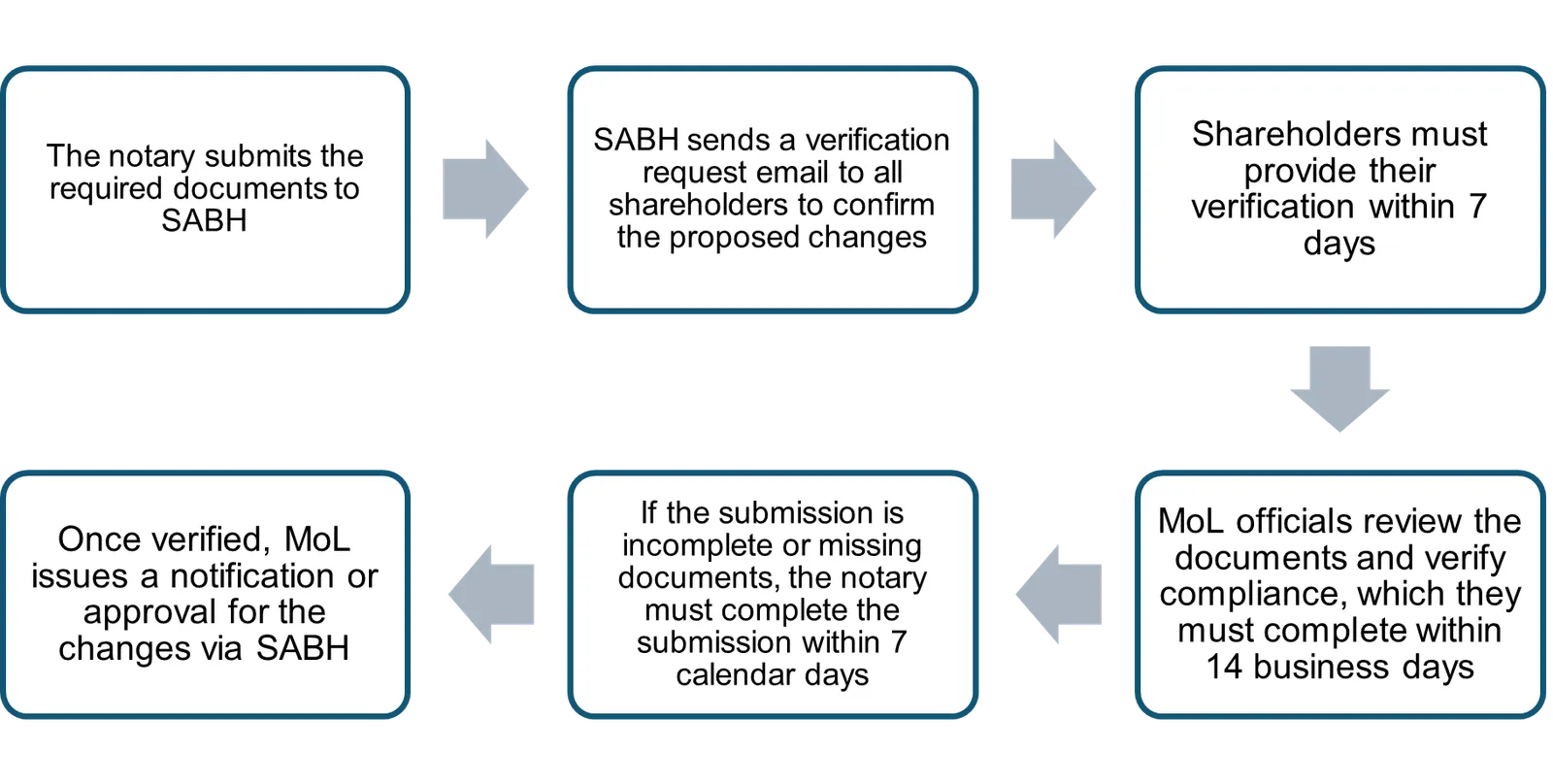
MoL Reg 49/2025 does not expressly regulate the requirement for emali verification to be sent to shareholders. However, based on MoL’s official publications and prevailing practice as of the date of this client update, such email-based shareholder verification continues to be implemented in the SABH system. This mechanism reflects the MoL’s effort to enhance transparency and ensure that corporate changes, particularly those relating to shareholding and management, accurately reflect the actual transactions and have been duly acknowledged by the relevant shareholders.
Accordingly, companies and investors must ensure that all information recorded in SABH, including email addresses and other contact details, is accurate and up to date. Maintaining correct and up-to-date data is essential to avoid delays during the verification process and to ensure that the company’s records remain complete and compliant.
- Mandatory disclosure of Ultimate Beneficial Ownership (UBO)
One of the significant updates introduced by MoL Reg 49/2025 compared to the previous regulation is the introduction of stricter UBO documentation requirements. Unlike the previous regulation which only required basic UBO information, MoL Reg 49/2025 now obliges companies to provide additional supporting documents to the notary as part of any company data or AoA amendment. Accordingly, in addition to the verification process, the following UBO documents must be submitted as follows:
(a) a power of attorney from the Board of Directors (BOD) authorising the notary to submit UBO data;
(b) a statement letter from the BoD identifying the UBO’s name; and
(c) an approval letter from the UBO of such changes.
These documents must be submitted electronically through SABH and kept up to date to ensure compliance with MoL requirements for company data amendments.
- Expanded annual reporting obligations
Another notable change under MoL Reg 49/2025 is the introduction of a mandatory electronic submission requirement for the Annual General Meeting of Shareholders (AGMS). The AGMS approval of the annual report must be set out in a notarial deed and submitted electronically to the MoL no later than 30 calendar days after the notarial deed date.
Failure to submit the annual report within the required timeframe may trigger administrative sanctions, such as:
(a) a written warning, if the company exceeds the deadline for submitting the notarial deed of the approved annual report, and
(b) blocking access to the corporation’s database in SABH, if the company fails to fulfill its obligations within 30 calendar days after receiving the written warning.
Corporate criminal liability enforcement
While the concept of corporate criminal liability is not new in Indonesia, it has traditionally been regulated only under certain sector-specific laws, such as the Anti-Corruption Law and the Environmental Protection and Management Law.
This approach has now shifted with the enactment of Law No. 1 of 2023 on the Criminal Code (Criminal Code), which officially came into force on 2 January 2026 and has subsequently been subject to certain amendments under Law No. 1 of 2026 on Criminal Penalty Adjustment (Adjusted Criminal Code) (together, the New Criminal Code).
The New Criminal Code expressly regulates corporate criminal liability under Articles 45 to 56, thereby providing a clearer and more comprehensive framework for the imposition of criminal liability on corporations.
We set out below a summary of the key provisions on corporate criminal liability under the New Criminal Code:
Aspect | New Criminal Code |
|---|---|
Definition of corporations |
(together, Corporations) (Article 45 of Criminal Code) |
Persons who commit the criminal act | A criminal offence may be deemed committed by a corporation if carried out by:3 1. members of management holding functional positions within the corporate structure (Functional Management); 2. persons acting for and on behalf of the corporation, based on an employment relationship or other legal relationship; 3. persons acting in the interest of the corporation within the scope of its business activities, whether individually or jointly; 4. persons outside the corporate structure who are able to control the corporation, including instruction-givers, controlling parties, or beneficial owners. (Article 46 and 47 of Criminal Code) |
Parties subject to criminal liability | Criminal liability may be imposed on:
(Article 49 of Adjusted Criminal Code) |
Attribution of criminal offences to Corporations | A criminal offence may be attributed to a Corporation if one or more of the following conditions are met:
(Article 48 of Criminal Code) |
Aspects to be considered under the Law | In imposing criminal sanctions on a corporation, the court is required to consider numerous factors, including the:
(Article 56 of Criminal Code) |
Sanctions4 |
(Article 119 of New Criminal Code) |
(a) payment of compensation; (b) remediation of the consequences of the criminal offence; (c) fulfillment of neglected obligations; (d) fulfillment of customary obligations; (e) funding of job training; (f) confiscation of assets or profits derived from the offence; (g) publication of the court judgment (which may affect corporate reputation and consumer trust); (h) revocation of certain licences; (i) permanent prohibition from conducting certain activities; (j) closure of all or part of business premises and/or activities; (k) suspension of all or part of business activities; and/or (l) dissolution of the corporation. (Article 120 of Adjusted Criminal Code) |
The New Criminal Code establishes a broad scope of corporate criminal liability, encompassing not only direct acts by management but also acts by employees, controlling parties, or other persons acting on behalf of the corporation. This focus on the degree of involvement in the corporate act aids enforcement by allowing authorities to trace responsibility through the corporate structure.
At the same time, it complements the evolving Business Judgment Rule, which now emphasiSes not only the outcome of a corporate decision but also the decision-making process itself, including the exercise of due care, good faith, and proper oversight. As such, robust governance and compliance measures can help mitigate both corporate and personal liability under the New Criminal Code.
When the New Criminal Code came into effect on 2 January 2026, any criminal offence that was already being adjudicated must apply the New Criminal Code, unless the law governing the offence is more favorable to the suspect or defendant.
Bill on Business Entities: towards a unified legal framework
The Indonesian Government is advancing a Bill on Business Entities (Bill), which is intended to serve as an umbrella regulation. The Bill aims to provide a unified, clear, and adaptive legal framework for business entities in Indonesia, in response to evolving economic and commercial dynamics. At present, regulations in this area remain fragmented. While limited liability companies are governed by Law No. 40 of 2007 (as amended), firms, limited partnerships (Commanditaire Vennootschap), and civil partnerships still refer to the colonial-era Indonesian Commercial Code (Kitab Undang-Undang Hukum Dagang).
The Bill has been included in the 2026 National Legislative Program (Program Legislasi Nasional – Prolegnas), indicating that it is positioned as a prospective legislative priority this year.
On a general level, the Bill is expected to regulate at least, the following key aspects:
(a) registration and establishment of limited liability companies and business entities;
(b) management and governance of limited liability companies and business entities;
(c) parties authorised to represent limited liability companies and business entities; and
(d) allocation of authority, role and responsibilities within limited liability companies and business entities
What’s Next?
We will continue to closely monitor ongoing legal developments in Indonesia and keep you updated as new information emerges. With many new legal regimes still being rolled out, many areas are still being aligned and synchronised.
S&T is well-positioned to provide guidance and practical support to help you navigate these changes with confidence. If you would like any assistance, please feel free to contact us.
References
01
A PMA Company is required to meet a minimum total investment value of more than IDR10 billion (excluding land and buildings) for each five-digit KBLI code per business location, unless otherwise specified by regulation).
02
For example, a company engaged in crypto-asset trading is required to maintain a minimum paid-up capital of at least IDR100 billion (approx. US$6,000,000)
03
Note: The New Criminal Code does not provide illustrative examples. In practice, these categories can include directors, senior officers, employees, third parties exercising de facto control and beneficial owners.
04
Note: If a criminal provision stipulates imprisonment, such a sanction will be converted into a criminal fine for corporations. For example, where the offence carries a maximum imprisonment term of less than 7 years, the maximum fine applicable to a corporation is Category VI, amounting to IDR 2 billion (approx. US$120,000).
FILE DOWNLOADS

AUTHORED BY



RELATED ARTICLES
Explore More
Interesting Insights
.webp&w=3840&q=75)
-1.webp&w=3840&q=75)